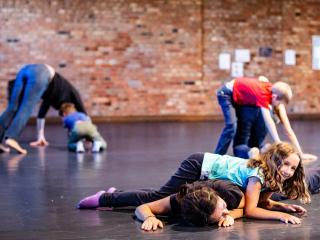
Games, movement tasks, and practical applications are the focus of this workshop. The theme-oriented classes demonstrate the practical application of somatic work. In this innovative approach for those working in the broad fields of education/school/social work/health care for babies, children, and adolescents, developmental and learning processes can be experienced and physically felt from the perspective of various somatic methods.
Being able to give relaxed support and touch where it is needed is possible if one’s own physical knowledge and analysis of movement observation are trained to such an extent that the worry of transgressing social conventions can be removed.
- Learning 3
- Games
- Movement tasks
- Support / Touch
- sexuality
- Movement observation / movement analysis
- Case studies
- Diploma
This workshop is also a module of the certified training in somatic pedagogy C.A.R.E.
Curriculum
Module 1
tba | Embryological Foundations of Life
Development of the organs and musculoskeletal system
Development of the nervous system and the senses
Development of the relationship to gravity
Development of attachment behavior
Module 2
31.01.-05.02.2025 | Childhood Movement Development
Physical Experience of Individual Movement
Primitive Reflexes, Postural and Postural Reflexes
Motor Development in the First Year of Life
Development of the Brain, Eyes, and Vestibular System
Module 3
April 12-16, 2025 | Movement, play, and interaction with children (0-3 years | 3-7 years)
Contact Improvisation for Adults and Children, Creativity and Dance
Body Awareness and Sensations, Mindfulness
Attachment Theory
Movement Development and Reflex Integration
Module 4
October 27-31, 2025 | Movement and Learning
Understanding the inextricable connection between movement and learning
Physical experience of the nervous system with theoretical understanding
Brain and nervous system development, movement observation and analysis, practical work, case studies
Module 5
31.01.-04.02.2026 | Movement, play, and interaction with children and young people (8-12 years | 13-16 years)
Practical experience for games, support, and frustration
Contact improvisation, dance, play, creativity
Body awareness, sensing, mindfulness
Touch and sexuality
Module 6
30.03.-03.04.2026 | Somatic work with children and adolescents in practice
Movement tasks, games
Support, touch, sexuality
Case studies
Conclusion and teaching samples
C.A.R.E. is a comprehensive training that combines somatic movement practice with neuroscientific and pedagogical insights to promote holistic human development – be it in a therapeutic, educational or personal context.
The C.A.R.E. program is designed to train self-connection and strengthen personal resilience, enabling a supportive relationship with others. Instead of reliving traumatic memories, C.A.R.E. supports participants in understanding the effects of the past on the nervous system and self-perception. Through targeted work on early childhood reflexes, embryonic development, and the foundations of self-regulation, dysfunctional survival strategies are identified and new resources for stability and well-being are created. To achieve this, C.A.R.E. combines innovative somatic approaches with neuroscientific findings as well as attachment and developmental theories.
This program is about developing the ability to support others in a resource- and bond-oriented manner, but also about addressing one's own patterns. By observing and understanding the connections between movement and nonverbal interaction, C.A.R.E. empowers participants to integrate these fundamental principles into their personal and professional practice.
https://youtu.be/HoazB7uJcUY
https://youtu.be/Yt_4ybMl4WI
C.A.R.E. stands for Creativity. Attachment. Resilience. Education and combines insights from Body-Mind Centering®, the Feldenkrais Method, and neurophysiological psychology to explore, embody, and communicate the relationship between our physiological developmental processes and emotions. This connection can enrich and transform your understanding, behavior, and work with others.
What is the added value of participating?
Understanding how our physiological and emotional systems are interconnected.
Learn ways to strengthen your own emotional, mental, and physical well-being.
Gain insights into how you can help others—especially children and adolescents—achieve greater body awareness and emotional regulation.
The goals of the training are
to know the basic principles of personality development
to recognize the profound interrelationships between the nonverbal and verbal dimensions of consciousness
to gain somatic and theoretical understanding of the development and learning processes taking place
to understand the importance of interaction/interpersonal emotional exchange for personality development and to incorporate it into contact
Understanding the physiological and emotional nature of learning processes
to understand the task and development of the brain as a control center in personality development
recognize different development aspects of the various interest groups
to integrate somatic approaches and methods into work with children
Importance, emphasis and foundations of communication with carers
To be able to recognize developmental and learning difficulties/blockages
The training provides (qualifies)
To be able to develop playful physical movement activities for different age groups that support children's personality development.
To be able to playfully incorporate "preverbal language," i.e., childhood movement development and reflexes, into different contexts.
To be able to recognize persistent primitive reflexes and understand how these influence movement development and then trigger possible changes.
To recognize compensation.
To be able to find or develop support options for developmental and learning difficulties/blockages.
To create an appreciative, acknowledging, and mindful atmosphere as a place for learning and play.
Leave a Reply